Poised on the banks of the Alzette River next to an old willow tree is a lady in lilac. Examine her abstract polygonal appearance a little more, and you’ll notice a fishtail where legs should be. The Mélusine of Luxembourg, according to local lore, was a maiden who married the city’s founder, Count Siegfried. She agreed to wed him on the condition that he granted her absolute privacy every Saturday, but did not tell him why.
With her magic, Mélusine erected a castle on the Bock of Luxembourg—a promontory of rocky cliffs overlooking the river—and bore him children. Their descendants would go on to rule as the House of Luxembourg. But one day, tempted by his curiosity, Siegfried broke his promise. Prying into her bath, he was startled to see not a woman, but a mermaid, and let out a yell. With bitter lamentation and being intruded upon, the water spirit slid out through the castle window and dove into the depths of the Alzette below.


The actual origin story of Luxembourg is indeed rooted in a castellum. Called Lucilinburhuc, it was first mentioned in 963 as acquired by Siegfried, a real-life count from the forested region of Ardennes that stretches across present-day Belgium, Luxembourg, Germany, and France. Through a series of marriage alliances, land acquisitions, and ties of vassalage and war, the small castle and its surrounding settlement expanded both in size and importance.
The years between 1312 and 1443 are considered to be Luxembourg’s golden age, when several members from the House of Luxembourg ascended to the throne of the Holy Roman Empire. A succession crisis in 1443 marked the start of almost 400 years of foreign rule, during which time Luxembourg was passed between various powers and reduced to a quarter of its size. The centuries of political disputes that took place in Europe eventually led to the creation of an independent Grand Duchy of Luxembourg in 1815 as well as to a national awakening. The consciousness of a new Luxembourgish identity can be best summarized by the sentiment, “Mir wëlle bleiwe was mir sinn—We want to remain what we are.” Originally a strophe from a patriotic song, it was adopted as the country’s official motto.

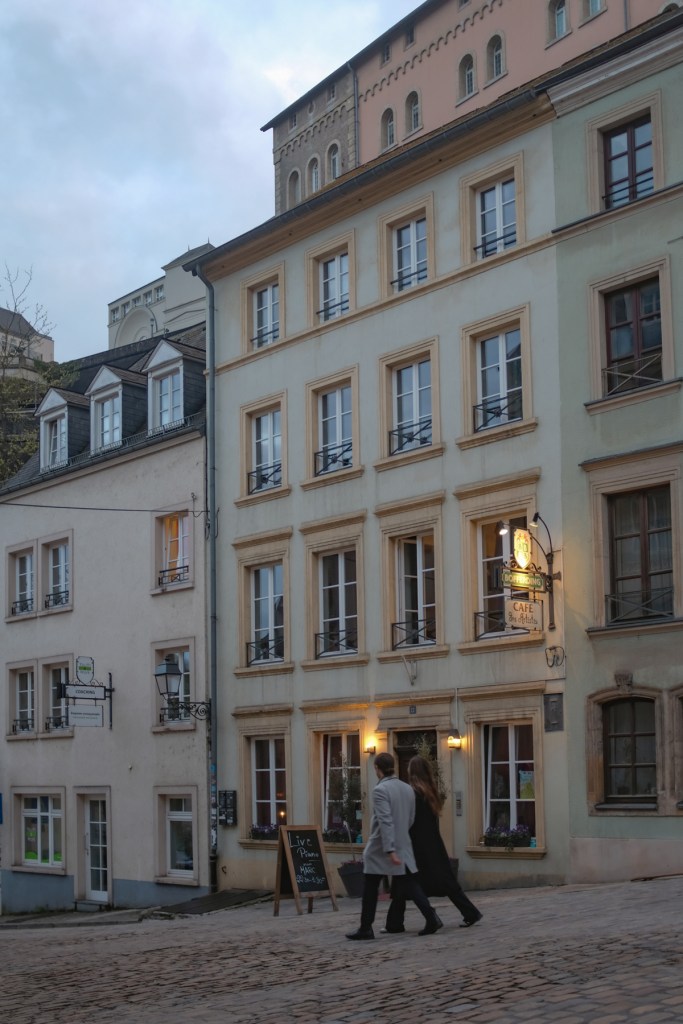
For a country of its size, Luxembourg holds several impressive accolades. As an officially trilingual country and co-capital of the European Union, its citizens are some of the world’s most capable polyglots, proficient in French, German, English, and the local Luxembourgish—a Germanic language with an abundant French lexicon. (Linguistically speaking, Luxembourgish would have been considered a dialect of German had there not been a state and regulatory body responsible for its standardization.) On the cobbled streets of the city, a hodgepodge of tongues can be heard. The barkeeps at the café-bar Vis-à-Vis, for example, switch effortlessly between the four languages depending on the clientele.
As the world’s sole remaining grand duchy, little Luxembourg has outlasted confrères like Tuscany, absorbed into Italy; Moscovy, predecessor of modern-day Russia; and Finland, now a republic. The country was granted grand ducal status as compensation in 1815 after losing portions of its land to Prussia, one of the precursors of Germany. In spite of its desirability as a strategic location for military conquests, Luxembourg managed to maintain its sovereignty. A price to pay for independence, however, was the undoing of its Vauban-fortified walls, the remnants of which still wrap around the old town laden with fairytale-like charm.

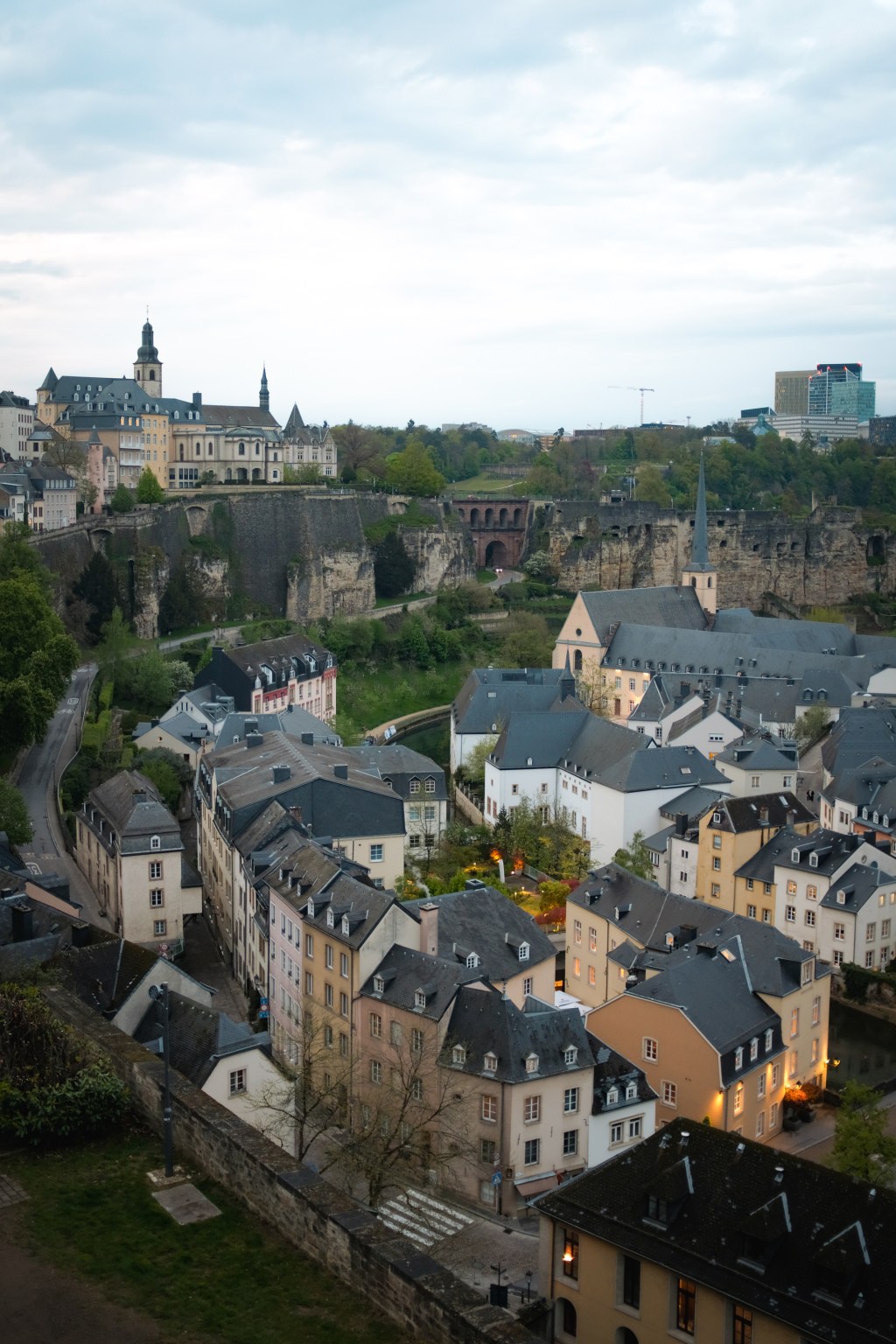
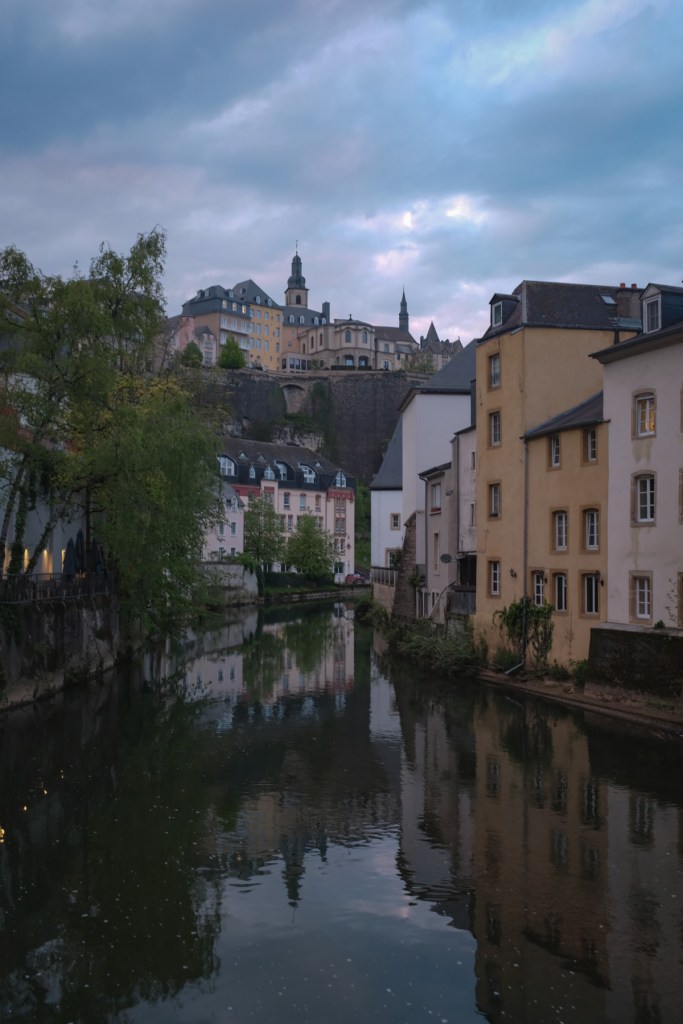
The historical center of Luxembourg is built on two strata. There is an upper town, or Ville Haute, that rests on the back of a large rock—the Bock—and a lower town called Grund, hugged by the quietly flowing Alzette. From vantage points such as the Citadelle du Saint Esprit next to the city courthouse and the cliffside Chemin de la Corniche, sublime views of the river valley and the cultural centerpiece of Neimënster unfurl. Connecting the two layers of the old town are a series of footbridges, elevators, and tunnels, among which are the rustic remains of the Bock Casemates and the picturesque double arch of the Pont du Stierchen.
Further upriver, Rives de Clausen is a hip and industrial-looking area of the city that has sprung up around a former brewery. Boasting colorful establishments and a cosmopolitan vibe, it is one of the best spots to sip on Luxembourg’s nightlife. To the north on a high plateau blanketed by grassy fields and moss-covered embankments, the Park Dräi Eechelen in the medieval-looking Fort Thüngen guards over a panoramic vista of all of old Luxembourg. If walking becomes too tiresome, free buses are readily available. In 2020, Luxembourg became the first country in the world to provide free public transportation for both residents and visitors as part of an initiative to reduce the reliance on cars.

Although it is one of the smallest countries in the world, Luxembourg is not a city-state. Its diverse terrains include the central Luxembourg plateau, the romantic Moselle river valley and Riesling vineyards to the east, the iron-rich red lands of De Minett to the south, and the hills and deciduous forests of the Ardennes to the north.
Located in the sparsely populated Éislek region in the Ardennes is Vianden. A small medieval town of no more than 2,500 people, it is home to the country’s most well-known castle, set spectacularly on a rocky throne overlooking the town. For most of the Middle Ages, it was the seat of the counts of Vianden and a powerful county separate from the rest of Luxembourg. During the 19th century, Vianden hosted the French author Victor Hugo on several occasions, who promoted the town abroad and preserved its riverfront beauty in a series of sketches.


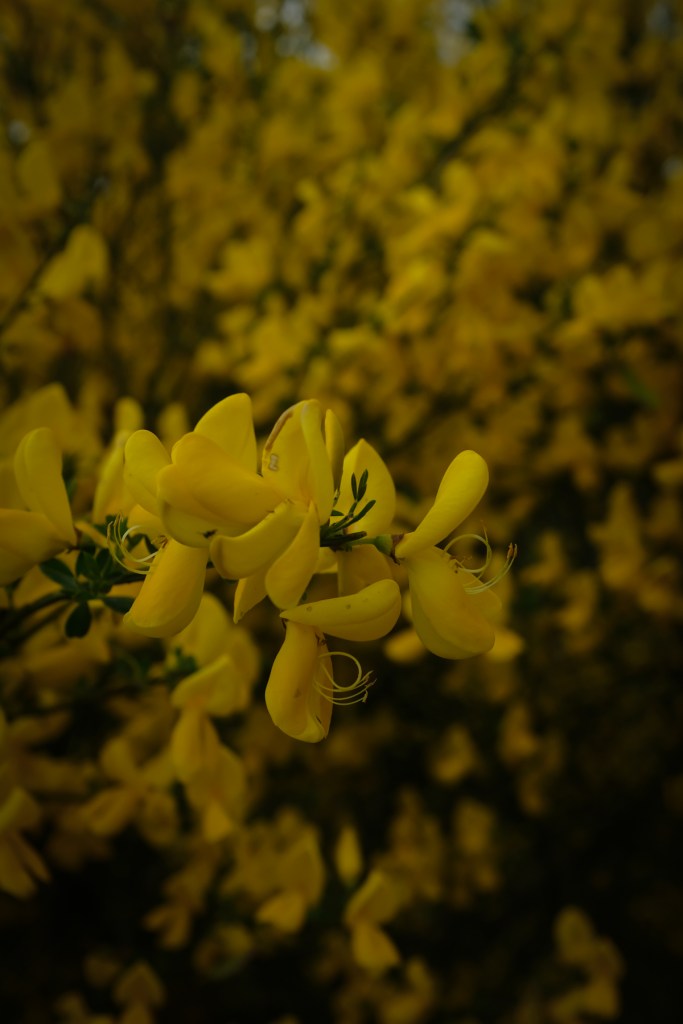


With its rustic châteaux, mystical tales, cobbled streets, green environs, and multilingual population, Luxembourg embodies many of the qualities that one would expect of Europe. All contained within an area of less than a thousand square miles (260 square kilometers), it is a worthy representation of a continent in miniature.
 Gregory Gioro
Leave a comment